What is a PLC?
A PROGRAMMABLE LOGIC CONTROLLER (PLC) is an industrial computer control system that continuously monitors the state of input devices and makes decisions based upon a custom program to control the state of output devices.
Almost any production line, machine function, or process can be greatly enhanced using this type of control system. However, the biggest benefit in using a PLC is the ability to change and replicate the operation or process while collecting and communicating vital information.
Another advantage of a PLC system is that it is modular. That is, you can mix and match the types of Input and Output devices to best suit your application.
History of PLCs
The first Programmable Logic Controllers were designed and developed by Modicon as a relay re-placer for GM and Landis.
- These controllers eliminated the need for rewiring and adding additional hardware for each new configuration of logic.
- The new system drastically increased the functionality of the controls while reducing the cabinet space that housed the logic.
- The first PLC, model 084, was invented by Dick Morley in 1969
- The first commercial successful PLC, the 184, was introduced in 1973 and was designed by Michael Greenberg.
What Is Inside A PLC?
The Central Processing Unit, the CPU, contains an internal program that tells the PLC how to perform the following functions:
- Execute the Control Instructions contained in the User's Programs. This program is stored in "nonvolatile" memory, meaning that the program will not be lost if power is removed
- Communicate with other devices, which can include I/O Devices, Programming Devices, Networks, and even other PLCs.
- Perform Housekeeping activities such as Communications, Internal Diagnostics, etc.
How Does A PLC Operate?
There are four basic steps in the operation of all PLCs; Input Scan, Program Scan, Output Scan, and Housekeeping. These steps continually take place in a repeating loop.
Four Steps In The PLC Operations
|
|
What Programming Language Is Used To Program A PLC?
While Ladder Logic is the most commonly used PLC programming language, it is not the only one. The following table lists of some of languages that are used to program a PLC.
Ladder Diagram (LD) Traditional ladder logic is graphical programming language. Initially programmed with simple contacts that simulated the opening and closing of relays, Ladder Logic programming has been expanded to include such functions as counters, timers, shift registers, and math operations.
Function Block Diagram (FBD) - A graphical language for depicting signal and data flows through re-usable function blocks. FBD is very useful for expressing the interconnection of control system algorithms and logic.
Structured Text (ST) – A high level text language that encourages structured programming. It has a language structure (syntax) that strongly resembles PASCAL and supports a wide range of standard functions and operators. For example;
| If Speed1 > 100.0 then Flow_Rate: = 50.0 + Offset_A1; Else Flow_Rate: = 100.0; Steam: = ON End_If; |
Instruction List (IL): A low level “assembler like” language that is based on similar instructions list languages found in a wide range of today’s PLCs.
|
LD
MPC LD ST RESET: ST |
R1 RESET PRESS_1 MAX_PRESS LD 0 A_X43 |
Sequential Function Chart (SFC) A method of programming complex control systems at a more highly structured level. A SFC program is an overview of the control system, in which the basic building blocks are entire program files. Each program file is created using one of the other types of programming languages. The SFC approach coordinates large, complicated programming tasks into smaller, more manageable tasks.
What Are Input/Output Devices?
|
INPUTS
|
 |
OUTPUTS
|
|||||||||
|
|
|
|||||||||
|
|
|
||||||||||
|
|
||||||||||
What Do I Need To Consider When Choosing A PLC?
There are many PLC systems on the market today. Other than cost, you must consider the following when deciding which one will best suit the needs of your application.
- Will the system be powered by AC or DC voltage?
- Does the PLC have enough memory to run my user program?
- Does the system run fast enough to meet my application’s requirements?
- What type of software is used to program the PLC?
- Will the PLC be able to manage the number of inputs and outputs that my application requires?
- If required by your application, can the PLC handle analog inputs and outputs, or maybe a combination of both analog and discrete inputs and outputs?
- How am I going to communicate with my PLC?
- Do I need network connectivity and can it be added to my PLC?
- Will the system be located in one place or spread out over a large area?
PLC Acronyms
The following table shows a list of commonly used Acronyms that you see when researching or using your PLC.
| ASCII | American Standard Code for Information Interchange |
| BCD | Binary Coded Decimal |
| CSA | Canadian Standards Association |
| DIO | Distributed I/O |
| EIA | Electronic Industries Association |
| EMI | ElectroMagnetic Interference |
| HMI | Human Machine Interface |
| IEC | International Electrotechnical Commission |
| IEEE | Institute of Electrical and Electronic Engineers |
| I/O | Input(s) and/or Output(s) |
| ISO | International Standards Organization |
| LL | Ladder Logic |
| LSB | Least Significant Bit |
| MMI | Man Machine Interface |
| MODICON | Modular Digital Controller |
| MSB | Most Significant Bit |
| PID | Proportional Integral Derivative (feedback control) |
| RF | Radio Frequency |
| RIO | Remote I/O |
| RTU | Remote Terminal Unit |
| SCADA | Supervisory Control And Data Acquisition |
| TCP/IP | Transmission Control Protocol / Internet Protocol |
portions of this tutorial contributed by www.modicon.com and www.searcheng.co.uk
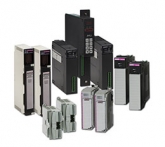
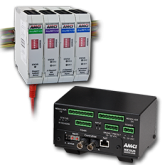
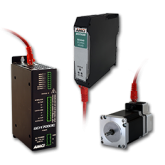
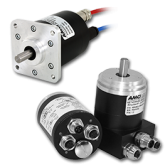
A small number of U.S. based tech companies design, manufacture and sell PLC modules. Advanced Micro Controls Inc (AMCI) is such a company, specializing in Position Sensing interfaces and Motion Control modules.
The company's products are listed below for your reference: